Periodic Table

Terbium

Lanthanide

Quick Facts about Terbium

Gd
  • solid- state of matter at room temperature
  • Stable- has at least one stable isotope
  • +3- common oxidation states in compounds
  • HEX- crystal structure, atomic arrangement in solid form
Dy

Terbium (Tb) is element 65 on the periodic table. Atomic mass of Tb: 158.9300 u. Tb is in period 6. Melting point of Tb: 1629.00 K.Density of Tb: 8.23 g/cm³.

Why Terbium Matters

Terbium in everyday life and industry

In Your Home

  • Green phosphors in fluorescent lights and displays use terbium
  • Anti-counterfeit marks on euro banknotes contain terbium (green under UV)

Industry Uses

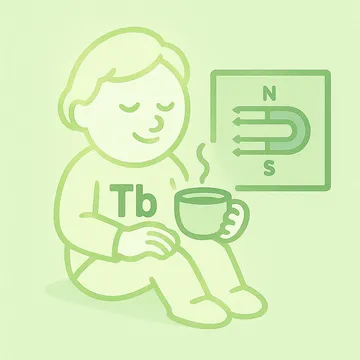
Defense/SonarTerfenol-D (TbFe2) is the most magnetostrictive material—changes shape in magnetic fields, used in sonar transducers
LightingGreen phosphors in tricolor fluorescent tubes and LEDs
EnergySolid oxide fuel cell research uses terbium-doped materials

In Your Body

✗ Not essential

Terbium has no known biological role. Used as a fluorescent probe in biochemistry research. Terbium can substitute for calcium in some biological studies.

Safety: Low toxicity to humans

Discovery of Terbium

Discovered by Carl Mosander in Sweden, 1843

Name origin: Named after Ytterby, a village in Sweden.

History & Events

1843
Named after Ytterby, Sweden (one of four elements)
1843
Discovered by Carl Gustaf Mosander in 1843
1843
Extremely difficult to separate from other rare earths initially
1843
Pure terbium wasn't isolated until the 20th century

About Terbium

Silvery metallic element belonging to the lanthanoids. Tb-159 is the only stable isotope, there are seventeen artificial isotopes. Discovered by G.G. Mosander in 1843.

Atomic Properties of Tb

Atomic Number of Tb
65
Atomic Mass of Tb
158.9300 u
Electron Configuration
[Xe] 4f9 6s2
Electronegativity
1.20
Block
f-block
Group
Period
6

Physical Properties of Tb

Phase (STP)
solid
Melting Point of Tb
1629.00 K
Boiling Point of Tb
3396.00 K
Density of Tb
8.2300 g/cm3

Thermal Properties

Heat of Vaporization
389.00 kJ/mol
Specific Heat
0.18 J/g·K
Molar Heat Capacity
28.91 J/mol·K
Thermal Conductivity
11.10 W/m·K

Atomic Radii

Calculated
175 pm
Covalent
168 pm
Van der Waals
233 pm

Common Misconceptions

Wrong:Terbium was named after a scientist like many elements.
Correct:Named after Ytterby, a tiny Swedish village. Four elements share this honor: yttrium, ytterbium, erbium, and terbium—all from the same quarry.
Wrong:Terfenol-D is just a magnetic material.
Correct:It's magnetostrictive—it physically changes shape in magnetic fields. This converts electrical signals to motion (sonar, precision actuators) with no moving parts.
Wrong:Any green phosphor will work for displays and lighting.
Correct:Terbium's green emission (545 nm) is exceptionally pure and efficient. It's essential for tricolor fluorescent tubes and remains important in LED phosphors.

Isotopes of Terbium

Terbium has 1 naturally occurring isotope, plus 2 notable radioactive isotopes.

IsotopeAtomic Mass (u)AbundanceHalf-LifeDecay Mode
14965Tb (Tb-149)Terbium-149 isotope148.923240%4.118 hoursα/EC
15965Tb (Tb-159)Terbium-159 isotope158.9253547100.00%
16165Tb (Tb-161)Terbium-161 isotope160.927570%6.906 daysβ⁻

Data source: NIH PubChem (aggregated from IUPAC, NIST)

Isotope Applications

Isotopes of Terbium have important real-world applications in science and industry.

Medical Applications

149Tb (with a half-life of 4.1 h) is being used in targeted radiotherapy using alpha particles for labeling radioimmunoconjugates in cancer treatments [458], [459]. 161Tb (with a half-life of 6.9 days) attached to a bioconjugate (two covalently linked molecules, one or more of which is a biomolecule), is being used in cancer therapy as a targeted radiation treatment of cancer cells [459], [460]. 161Tb is being used for imaging as it allows for on-line monitoring of its distribution using gamma cameras [460]. 149Tb is produced by the reaction 142Nd(12C,5n) 149Dy, which is followed by a subsequent positron decay reaction 149Dy→ 149Tb+β +. It can also be produced by the reaction 141Pr(12C,4n) 149Tb; beam geometry is important for satisfactory yield of 149Tb (Fig. IUPAC.65.1) [461].

Abundance

Earth's Crust
1.2 mg/kg
Seawater
1.40×10⁻⁷ mg/L

Uses

It is used in modest amounts in special lasers and solid-state devices.

Sources

Found with other rare earths in monazite sand, which typically contain 0.03% terbium. Other sources are xenotime and euxenite, both of which are oxide mixtures that can contain up to 1% terbium.

Geochemistry

Goldschmidt
litophile
Geochemical Class
rare earth & related

Test Your Knowledge

Loading quiz...