Periodic Table

Neodymium

Lanthanide

Quick Facts about Neodymium

Pr
  • solid- state of matter at room temperature
  • Stable- has at least one stable isotope
  • +3- common oxidation states in compounds
  • HEX- crystal structure, atomic arrangement in solid form
Pm

Neodymium (Nd) is element 60 on the periodic table. Atomic mass of Nd: 144.2400 u. Nd is in period 6. Melting point of Nd: 1297.00 K.Density of Nd: 7.01 g/cm³.

Why Neodymium Matters

Neodymium in everyday life and industry

In Your Home

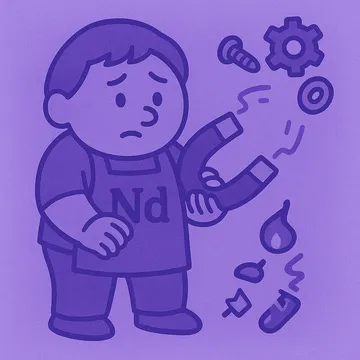
  • Headphones and earbuds use tiny but powerful neodymium magnets
  • Hard drives contain neodymium magnets for read/write head positioning
  • Magnetic phone mounts and closures often use NdFeB magnets

Industry Uses

Renewable EnergyWind turbine generators use massive neodymium magnets (up to 600 kg per MW)
AutomotiveElectric vehicle motors rely on NdFeB magnets for high power density
ManufacturingMagnetic separators, MRI machines, and industrial motors

In Your Body

✗ Not essential

Neodymium has no known biological role. Dust may cause lung issues if inhaled.

Safety: Low toxicity but can irritate skin and eyes. Neodymium magnet ingestion is dangerous—multiple magnets can pinch intestines together, requiring surgery.

Discovery of Neodymium

Discovered by C.F. Aver von Welsbach in Austria, 1925

Name origin: Greek: neos and didymos (new twin).

History & Events

1885
Named from Greek 'neos didymos' meaning new twin
1885
Separated from didymium by Carl Auer von Welsbach in 1885
1982
NdFeB magnets invented in 1982 revolutionized technology
1885
Now critical for green technology

About Neodymium

Soft, bright silvery lanthanide. Seven natural isotopes—Nd-144 is the only radioactive one (α decay, t1/2 ~2.3×10¹⁵ years, used in Sm-Nd geochronology). Reactive in air. Colors glass violet-purple (dichroic). Critical component of Nd2Fe14B permanent magnets—the strongest available. Discovered 1885 by Carl Auer von Welsbach, separating didymium into Pr and Nd ('new twin').

Atomic Properties of Nd

Atomic Number of Nd
60
Atomic Mass of Nd
144.2400 u
Electron Configuration
[Xe] 4f4 6s2
Electronegativity
1.14
Block
f-block
Group
Period
6

Physical Properties of Nd

Phase (STP)
solid
Melting Point of Nd
1297.00 K
Boiling Point of Nd
3347.00 K
Density of Nd
7.0100 g/cm3

Thermal Properties

Heat of Fusion
7.10 kJ/mol
Heat of Vaporization
289.00 kJ/mol
Specific Heat
0.19 J/g·K
Molar Heat Capacity
27.45 J/mol·K

Atomic Radii

Calculated
185 pm
Covalent
174 pm
Van der Waals
239 pm

Common Misconceptions

Wrong:Neodymium magnets are tough and durable.
Correct:NdFeB magnets are extremely brittle—they shatter like ceramics if dropped or allowed to snap together. The nickel coating protects against corrosion, not impact.
Wrong:Small magnets are harmless toys for children.
Correct:Swallowed NdFeB magnets are a medical emergency. Multiple magnets attract through intestinal walls, causing perforation, sepsis, and death. Many countries now ban small magnet sets.
Wrong:China dominates neodymium because all deposits are there.
Correct:Rare earth deposits exist worldwide (US, Australia, Brazil). China's dominance is in processing—they built the refining infrastructure while others didn't.

Isotopes of Neodymium

Neodymium has 6 naturally occurring isotopes, plus 2 notable radioactive isotopes.

IsotopeAtomic Mass (u)AbundanceHalf-LifeDecay Mode
14060Nd (Nd-140)Neodymium-140 isotope139.909550%3.37 daysEC, β⁺
14260Nd (Nd-142)Neodymium-142 isotope141.90772927.15%
14360Nd (Nd-143)Neodymium-143 isotope142.9098212.17%
14460Nd (Nd-144)Neodymium-144 isotope143.91009323.80%2.29×10¹⁵ yearsα
14560Nd (Nd-145)Neodymium-145 isotope144.91257938.293%
14660Nd (Nd-146)Neodymium-146 isotope145.913122617.19%
14860Nd (Nd-148)Neodymium-148 isotope147.91689935.756%
15060Nd (Nd-150)Neodymium-150 isotope149.92090225.638%

Data source: NIH PubChem (aggregated from IUPAC, NIST)

Isotope Applications

Isotopes of Neodymium have important real-world applications in science and industry.

Geochronology & Dating

143Nd is a radiogenic isotope produced by decay of 147Sm, with a half-life of 1.06×10¹¹ years. Thus, the isotope-amount ratio n(143Nd)/n(144Nd) can be used for dating rocks on long time scales and as a chemical tracer in geochemistry (Fig. IUPAC.60.1) [427], [428]. The very small accumulation of 142Nd in billion-year-old metamorphosed rocks from Greenland [from the relatively short-lived (about 68×106 years) alpha decay of 146Sm] provided evidence that the crust of the Earth formed before the young planet was more than 100×106 years old. This is because only a short amount of time could have elapse to incorporate the 146Sm parent radionuclide into the ancient Greenland minerals before it decayed [429], [430].

Abundance

Earth's Crust
41.5 mg/kg
Seawater
2.80×10⁻⁶ mg/L

Uses

Used in making artificial ruby for lasers. Also in ceramics and for a special lens with praseodymium. Also to produce bright purple glass and special glass that filters infrared radiation. Makes up 18% of Misch metal, which is used in making steel.

Sources

Made from electrolysis of its halide salts, which are made from monazite sand.

Geochemistry

Goldschmidt
litophile
Geochemical Class
rare earth & related

Test Your Knowledge

Loading quiz...