Periodic Table

Potassium

Alkali Metal

Quick Facts about Potassium

Ar
  • solid- state of matter at room temperature
  • Stable- has at least one stable isotope
  • +1- common oxidation states in compounds
  • BCC- crystal structure, atomic arrangement in solid form
Ca

Potassium (K) is element 19 on the periodic table. Atomic mass of K: 39.0980 u. K is in period 4, group 1. Melting point of K: 336.70 K.Density of K: 0.89 g/cm³.

Why Potassium Matters

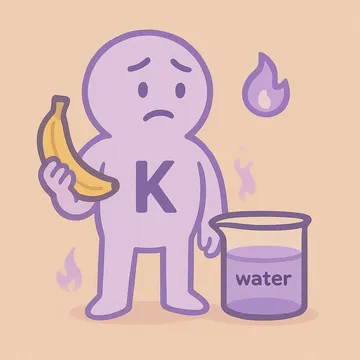
The element in every banana that keeps your heart beating

In Your Home

  • Bananas and potatoes (high potassium foods)
  • Salt substitutes (potassium chloride)
  • Fertilizers for your garden
  • Some fire extinguishers

Industry Uses

AgriculturePotash fertilizer (KCl) is essential for crop growth
FoodSalt substitute for low-sodium diets
ChemicalPotassium hydroxide (KOH) in soap and batteries
MedicalIV potassium for patients with deficiency

In Your Body

✓ Essential for life

Critical for nerve impulses, muscle contraction, and heart rhythm. Works with sodium to maintain cell membrane potential. Your body contains about 140g of potassium.

Safety: Both deficiency (hypokalemia) and excess (hyperkalemia) are dangerous. High potassium can stop the heart (used in lethal injections).

Discovery of Potassium

Discovered by Sir Humphrey Davy in England, 1807

Name origin: English: pot ash; symbol from Latin: kalium, (alkali).

History & Events

1807
Discovery
Humphry Davy isolated potassium by electrolyzing molten potash—first metal isolated by electrolysis
1840
Fertilizer Revolution
Justus von Liebig identified potassium as essential plant nutrient, launching the fertilizer industry
1957
Sodium-Potassium Pump
Jens Christian Skou discovered the Na+/K+-ATPase pump, winning the 1997 Nobel Prize

Why "K" for Potassium?

KKalium(Latin)

The symbol K comes from "Kalium," the Latin name derived from Arabic "qali" meaning "alkali" (plant ashes). The English name "Potassium" comes from "potash," the ash residue left in pots after burning plant material.

About Potassium

Soft silvery metallic element belonging to group 1 of the periodic table (alkali metals). Occurs naturally in seawater and a many minerals. Highly reactive, chemically, it resembles sodium in its behavior and compounds. Discovered by Sir Humphry Davy in 1807.

Atomic Properties of K

Atomic Number of K
19
Atomic Mass of K
39.0980 u
Electron Configuration
[Ar] 4s1
Electronegativity
0.82
Block
s-block
Group
1
Period
4

Physical Properties of K

Phase (STP)
solid
Melting Point of K
336.70 K
Boiling Point of K
1032.00 K
Density of K
0.8900 g/cm3

Thermal Properties

Heat of Fusion
102.50 kJ/mol
Heat of Vaporization
2.33 kJ/mol
Specific Heat
0.76 J/g·K
Molar Heat Capacity
29.60 J/mol·K
Thermal Conductivity
79.00 W/m·K

Atomic Radii

Calculated
220 pm
Covalent
196 pm
Van der Waals
275 pm
Metallic
203 pm

Common Misconceptions

Wrong:Bananas are the best source of potassium.
Correct:Many foods have more potassium: potatoes, spinach, beans, and avocados all beat bananas per serving.
Wrong:K is for kalium, a made-up word.
Correct:Kalium comes from Arabic 'al-qaliy' (plant ashes). Germans still call it Kalium.
Wrong:Potassium and sodium are interchangeable in diet.
Correct:They have opposite effects! Most people need more potassium and less sodium.

Isotopes of Potassium

Potassium has 3 naturally occurring isotopes, plus 1 notable radioactive isotope.

IsotopeAtomic Mass (u)AbundanceHalf-LifeDecay Mode
3819K (K-38)Potassium-38 isotope37.96908120%7.64 minutesβ⁺, EC
3919K (K-39)Potassium-39 isotope38.9637064993.26%
4019K (K-40)Potassium-40 isotope39.963998170.0117%
4119K (K-41)Potassium-41 isotope40.961825266.730%

Data source: NIH PubChem (aggregated from IUPAC, NIST)

Isotope Applications

Isotopes of Potassium have important real-world applications in science and industry.

Geochronology & Dating

The amount ratio n(40K)/n(40Ar) is used in potassium-argon dating by geologists, archaeologists, and paleoanthropologists to determine the age of rocks. This dating method is based on the radioactive decay of 40K, having a half-life of 1.248×10⁹ years, to 40Ar. When lava crystalizes, 40Ar can no longer escape and begins increasing in concentration in a rock (Fig. IUPAC.19.1) [179], [180].

Medical Applications

38K, which has a half-life of 7.6 min and is produced by a nuclear reaction involving 38Ar and 40Ar as targets, is a widely used blood-flow tracer. Because 38Ar is more expensive, 40Ar, which also offers many additional advantages as a target, is more commonly used to produce 38K for medical purposes [75], [176], [181].

Abundance

Earth's Crust
20.9 g/kg
Seawater
399.0 mg/L

Uses

Used as potash in making glass and soap. Also as saltpeter, potassium nitrate (KNO3) to make explosives and to color fireworks in mauve. Formerly called kalium (K). Vital to function of nerve and muscle tissues.

Sources

Found in minerals like carnallite [KMgCl3·6H2O] and sylvite (potassium chloride, KCl). Pure metal is produced by the reaction of hot potassium chloride and sodium vapors in a special retort.

Geochemistry

Goldschmidt
litophile
Geochemical Class
alkali metal

Test Your Knowledge

Loading quiz...