Atomic Properties of Ca
- Atomic Number of Ca
- 20
- Atomic Mass of Ca
- 40.0780 u
- Electron Configuration
- [Ar] 4s2
- Electronegativity
- 1.00
- Block
- s-block
- Group
- 2
- Period
- 4
Calcium (Ca) is element 20 on the periodic table. Atomic mass of Ca: 40.0780 u. Ca is in period 4, group 2. Melting point of Ca: 1115.00 K.Density of Ca: 1.55 g/cm³.
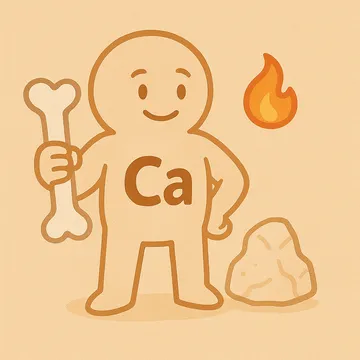
The element that builds your bones and makes fireworks sparkle orange
Most abundant mineral in your body (~1kg). 99% in bones and teeth. Also essential for muscle contraction, blood clotting, and nerve signaling.
Discovered by Sir Humphry Davy in England, 1808
Name origin: Latin: calx, calcis (lime).
Soft grey metallic element belonging to group 2 of the periodic table. Used a reducing agent in the extraction of thorium, zirconium and uranium. Essential element for living organisms.
Calcium has 5 naturally occurring isotopes, plus 4 notable radioactive isotopes.
| Isotope | Atomic Mass (u) | Abundance | Half-Life | Decay Mode |
|---|---|---|---|---|
| 4020Ca (Ca-40)Calcium-40 isotope | 39.96259086 | 96.94% | Stable | No observed decay |
| 4120Ca (Ca-41)Calcium-41 isotope | 40.9622781 | 0% | 99,400 years | EC |
| 4220Ca (Ca-42)Calcium-42 isotope | 41.95861783 | 0.6470% | Stable | No observed decay |
| 4320Ca (Ca-43)Calcium-43 isotope | 42.95876644 | 0.1350% | Stable | No observed decay |
| 4420Ca (Ca-44)Calcium-44 isotope | 43.95548156 | 2.086% | Stable | No observed decay |
| 4520Ca (Ca-45)Calcium-45 isotope | 44.9561866 | 0% | 162.6 days | β⁻ |
| 4620Ca (Ca-46)Calcium-46 isotope | 45.953689 | 4.00×10⁻³% | Stable | No observed decay |
| 4720Ca (Ca-47)Calcium-47 isotope | 46.9545463 | 0% | 4.536 days | β⁻ |
| 4820Ca (Ca-48)Calcium-48 isotope | 47.95252276 | 0.1870% | 6.4 × 10¹⁹ years | 2β⁻ |
Data source: NIH PubChem (aggregated from IUPAC, NIST)
Selected uses of notable Calcium isotopes.
Geological dating; groundwater tracing; bone metabolism studies
Calcium metabolism research; bone studies; tracer in biological systems
Calcium uptake studies; short-term biological tracer
Applications reference: IUPAC Isotopes Matter and NIH PubChem.
Used by many forms of life to make shells and bones. Virtually no use for the pure metal, however two of its compounds are, lime (CaO) and gypsum (CaSO4), are in great demand by a number of industries.
Obtained from minerals like chalk, limestone & marble. Pure metal is produced by replacing the calcium in lime (calcium carbonate, CaCO3) with aluminium in hot, low pressure retorts.
Loading quiz…
The chemistry behind Calcium: