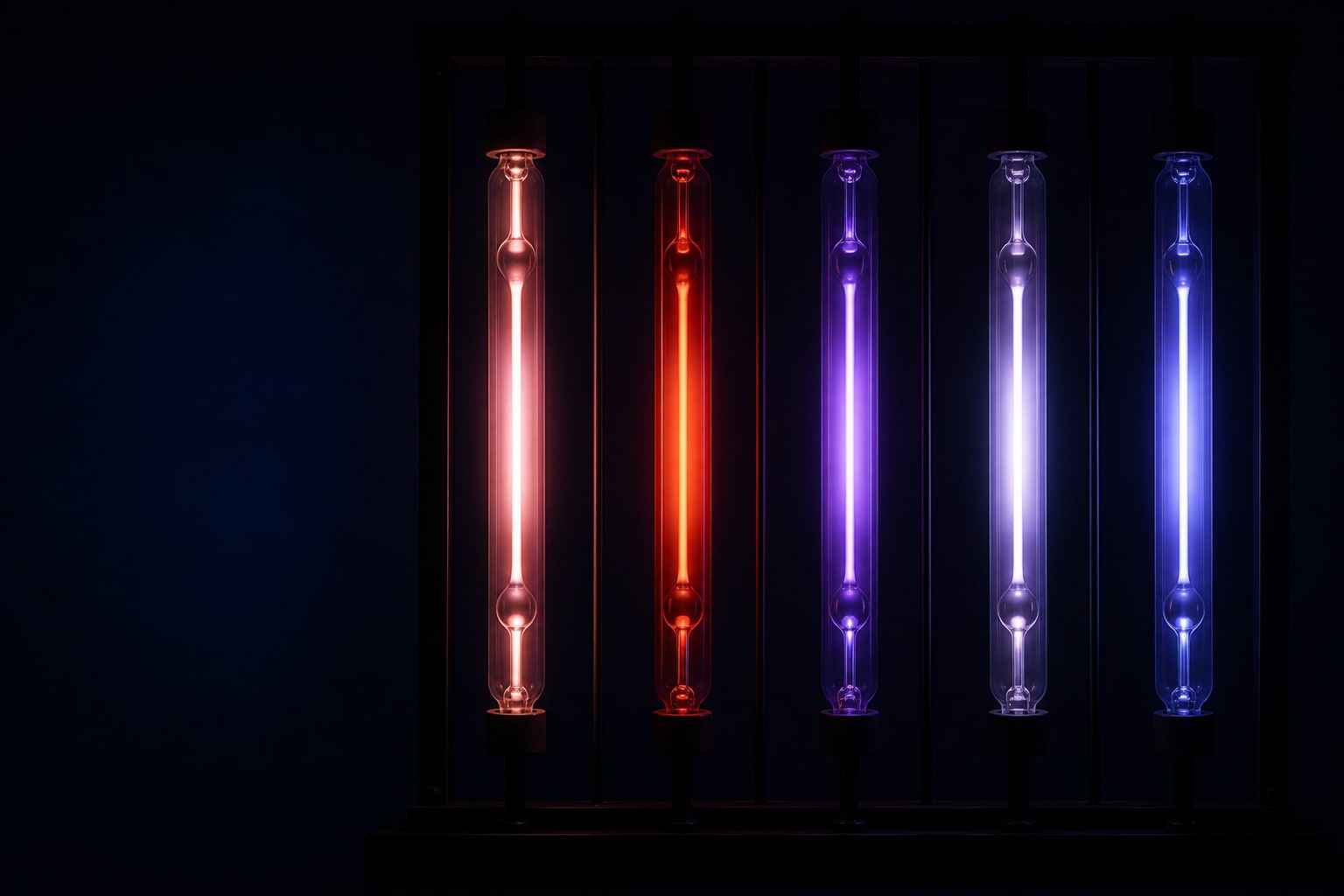
The noble gases occupy Group 18 of the periodic table. Helium through radon have filled valence shells and are extremely unreactive under ordinary conditions. Oganesson belongs to the same group, but only a few atoms have been produced, so its bulk properties remain theoretical.
Properties of Noble Gases
The observed noble gases from helium through radon share several distinctive properties due to their filled valence shells. They have very low boiling points. Helium has the lowest boiling point of any element at −268.93 °C (4.22 K). They are colorless, odorless, and tasteless under standard conditions and exist as monatomic gases. Oganesson is expected to depart from some of these trends, but no macroscopic sample exists for measurement.
The Noble Gases
Each noble gas has unique characteristics and applications:
Used in balloons, MRI machine coolant (liquid helium at 4.2 K), and deep-sea diving gas mixtures. The second most abundant element in the universe after hydrogen.
Used in neon signs, producing a distinctive orange-red glow when electrically excited. Also used in high-voltage indicators and lightning arresters.
The most abundant noble gas in Earth's atmosphere at 0.93% by volume. Widely used as a shield gas in welding and in incandescent and fluorescent lighting.
Used in fluorescent lamps, photographic flash equipment, and high-performance airport runway lights. Produces a brilliant white light.
Used in vehicle headlights (HID lamps), as a general anesthetic, and in ion propulsion systems for spacecraft. Can form compounds such as XeF₂, disproving early assumptions about noble gas inertness.
A radioactive gas produced by radium decay. Accumulates in buildings from soil and rock, the second leading cause of lung cancer after smoking. Radon testing is recommended for all homes.
A synthetic superheavy element. Theoretical calculations predict it may actually be a solid at room temperature, unlike all other noble gases, due to strong relativistic effects on its electron shell.
Noble Gas Compounds
For decades, noble gases were called "inert gases" because they were believed to be completely unreactive. In 1962 Neil Bartlett prepared a xenon-platinum fluoride material, often represented as XePtF₆, that provided the first clear evidence of a noble-gas compound. Its exact solid composition is more complicated than that simple formula suggests. Many xenon compounds and a smaller number of krypton compounds are now known, including XeF₂, XeF₄, XeF₆, and KrF₂.