Periodic Table

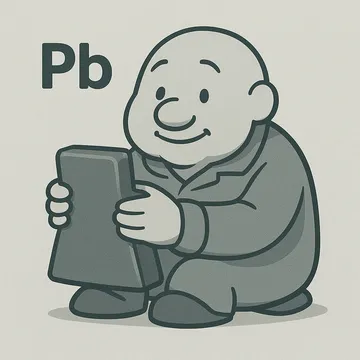
Lead

Post Transition Metal

Quick Facts about Lead

Tl
  • solid- state of matter at room temperature
  • Stable- has at least one stable isotope
  • +4, +2- common oxidation states in compounds
  • FCC- crystal structure, atomic arrangement in solid form
Bi

Lead (Pb) is element 82 on the periodic table. Atomic mass of Pb: 207.2000 u. Pb is in period 6, group 14. Melting point of Pb: 600.61 K.Density of Pb: 11.34 g/cm³.

Why Lead Matters

The heavy metal that built Rome and still shields us from radiation

In Your Home

  • Car batteries (lead-acid)
  • Old paint in pre-1978 homes (hazard)
  • Fishing weights and ammunition

Industry Uses

BatteryLead-acid batteries for vehicles and backup power
MedicalRadiation shielding in X-ray rooms
ConstructionSoundproofing and vibration damping
AmmunitionBullets and shot (being phased out)

In Your Body

✗ Not essential

No biological function. Toxic heavy metal that accumulates in bones, mimics calcium. Lead poisoning causes neurological damage, especially in children.

Safety: Highly toxic. Causes lead poisoning affecting brain, kidneys, and blood. No safe level for children. Historic disaster from leaded gasoline and paint.

Discovery of Lead

Discovered by Known to the ancients.,

Name origin: Anglo-Saxon: lead; symbol from Latin: plumbum.

History & Events

3000 BCE
Ancient Mining
Lead mining began in Anatolia. Romans used lead extensively for pipes and cookware.
1921
Tetraethyl Lead
Thomas Midgley added lead to gasoline to prevent knocking—later found to be disastrous
1996
Leaded Gas Banned
US banned leaded gasoline after decades of environmental lead contamination

Why "Pb" for Lead?

PbPlumbum(Latin)

The symbol Pb comes from "Plumbum," the Latin word for lead. This is also the origin of "plumbing," as Romans used lead pipes. The English name "Lead" comes from Old English "lēad."

About Lead

Heavy, soft, malleable metal with a bluish-white color that tarnishes to dull grey. Four stable isotopes, all primordial—Pb-206, 207, and 208 are radiogenic end-products of uranium and thorium decay chains. Lead-acid batteries consume ~80% of production. Symbol Pb from Latin 'plumbum' gives us 'plumber' (Romans used lead pipes). Pb-208 is the heaviest stable nuclide.

Atomic Properties of Pb

Atomic Number of Pb
82
Atomic Mass of Pb
207.2000 u
Electron Configuration
[Xe] 4f14 5d10 6s2 6p2
Electronegativity
1.87
Block
p-block
Group
14
Period
6

Physical Properties of Pb

Phase (STP)
solid
Melting Point of Pb
600.61 K
Boiling Point of Pb
2022.00 K
Density of Pb
11.3400 g/cm3

Thermal Properties

Heat of Fusion
4.77 kJ/mol
Heat of Vaporization
177.80 kJ/mol
Specific Heat
0.13 J/g·K
Molar Heat Capacity
26.84 J/mol·K
Thermal Conductivity
35.30 W/m·K

Atomic Radii

Calculated
180 pm
Covalent
144 pm
Van der Waals
202 pm
Metallic
150 pm

Common Misconceptions

Wrong:Pencil 'lead' is made of lead.
Correct:Pencils use graphite (carbon), never lead. The name stuck from when graphite was mistaken for lead ore.
Wrong:Lead poisoning is a thing of the past.
Correct:Lead remains a serious problem in old paint, contaminated soil, and some water systems (Flint, Michigan).
Wrong:A little lead exposure is okay.
Correct:There is no safe level of lead exposure, especially for children. Even low levels affect brain development.

Isotopes of Lead

Lead has 4 naturally occurring isotopes.

IsotopeAtomic Mass (u)AbundanceHalf-LifeDecay Mode
20482Pb (Pb-204)Lead-204 isotope203.9730441.400%
20682Pb (Pb-206)Lead-206 isotope205.974465724.10%
20782Pb (Pb-207)Lead-207 isotope206.975897322.10%
20882Pb (Pb-208)Lead-208 isotope207.976652552.40%

Data source: NIH PubChem (aggregated from IUPAC, NIST)

Isotope Applications

Isotopes of Lead have important real-world applications in science and industry.

Geochronology & Dating

The three natural radioactive-decay chains beginning with 238U, 235U, and 232Th each have comparable half-lives that are much longer than the radioactive isotopes that follow until the production of stable isotopes of 206Pb, 207Pb, and 208Pb, respectively. Therefore, one can measure the relative amounts of the radiogenic isotopes of lead to determine the length of time that has elapsed since uranium and thorium atoms were incorporated into rocks and minerals. Typically, this method is used to date minerals that are tens of millions to billions of years old. The uranium-lead dating method was used to determine some of the first accurate ages of the Earth (about 4.55×10⁹ years) [554], [555], [556].

Abundance

Earth's Crust
14.0 mg/kg
Seawater
3.00×10⁻⁵ mg/L

Uses

Used in solder, shielding against radiation and in batteries.

Sources

Found most often in ores called galena or lead sulfide (PbS). Some is found in its native state.

Geochemistry

Goldschmidt
chalcophile

Test Your Knowledge

Loading quiz...